
Mixed Materials in Modern Kitchen Remodels: Wood, Stone & Metal Done Right
The kitchen has always been the heart of the home, but today’s homeowners are asking more of it than ever before. They want a space that’s warm but sleek, natural yet durable, personal yet timeless. That’s a tall order for any single material to fill on its own — which is exactly why mixed-materials in kitchen design has become one of the most exciting trends in modern remodeling. At Complete Construction, we’ve helped countless homeowners navigate the beautiful complexity of blending wood, stone, and metal into kitchens that feel intentional, cohesive, and genuinely livable.
The idea of mixing materials can feel a little intimidating at first. Too many textures, too many tones — won’t it look busy? The answer is a confident no, as long as you understand the principles behind why these three materials work so well together. Wood brings warmth and organic softness. Stone brings weight, permanence, and a kind of quiet luxury. Metal introduces edge, reflectivity, and a modern sharpness that keeps everything from feeling too rustic. Each one balances the others, and when you get the proportions right, the result is a kitchen that feels layered and lived-in rather than showroom-stiff.
Why Mixed Materials Are Worth the Investment
According to the National Association of Realtors, kitchen remodels consistently rank among the highest-return home improvement projects, with well-executed renovations recovering up to 67% of costs at resale. But beyond the numbers, there’s a deeper reason homeowners are gravitating toward mixed materials: they hold up emotionally over time. A kitchen that relies entirely on one surface — say, all white quartz and painted cabinets — can feel clinical or trend-dependent within a few years. When you introduce varied textures, the eye has places to rest and explore, and the space develops a richness that doesn’t fade.
How to Balance Wood, Stone, and Metal Without Overwhelming the Eye
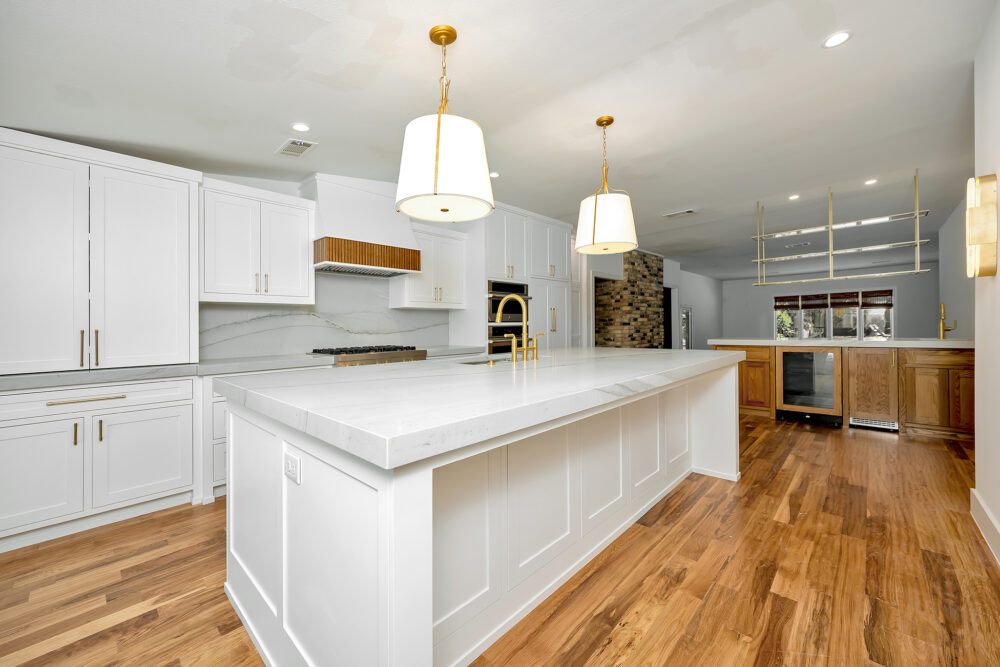
The key to making mixed materials work is establishing a visual hierarchy. Think of it this way: one material leads, one supports, and one accents. In a kitchen where warmth is the primary goal, wood might lead through cabinetry or open shelving, with stone stepping in as the countertop and metal appearing in hardware, light fixtures, or a range hood. In a more contemporary kitchen, stone could take center stage with a dramatic waterfall island, while wood grounds the perimeter cabinets and metal punctuates with cabinet pulls and a sleek faucet.
The 60-30-10 rule — borrowed from interior design’s color theory — translates beautifully here. Sixty percent of your kitchen’s visual surface area carries your dominant material, thirty percent supports it with a secondary material, and ten percent comes from your accent. This isn’t a rigid formula, but it’s a useful starting point when clients come to us unsure of how to begin.
Choosing the Right Finishes and Undertones
Where mixed-material kitchens go wrong is usually not in the materials themselves but in their undertones. Warm-toned wood — honey oak, walnut, or teak — wants stone and metal companions with golden or amber undertones. Cooler, grayer woods pair better with slate-toned stone and brushed nickel or matte black metal finishes. Mismatched undertones create a subtle visual tension that’s hard to name but easy to feel, like a chord that’s just slightly off.
A Note on Texture and Longevity
One underappreciated advantage of mixing materials is what it does for the long life of your kitchen. A scratch on a matte wood cabinet reads as character. A small chip in a stone edge blends into its natural variation. Fingerprints vanish on brushed metal in a way they never do on a high-gloss painted surface. When you design with texture from the start, you’re designing a kitchen that ages gracefully rather than one you’ll be exhausted by in five years.
Bringing It All Together
A mixed-material kitchen isn’t about collecting beautiful things — it’s about creating a conversation between them. Wood, stone, and metal each have a voice, and the goal of a great remodel is to let all three speak without any one of them shouting. At Complete Construction, that’s the kind of thoughtful, crafted result we work toward on every project.
Whether you’re starting with a clear vision or just a gut feeling that your current kitchen isn’t working, we’re here to help you find the right combination and execute it with care. If you’re ready to explore what mixed materials could do for your kitchen, reach out to the team at Complete Construction and let’s start the conversation.